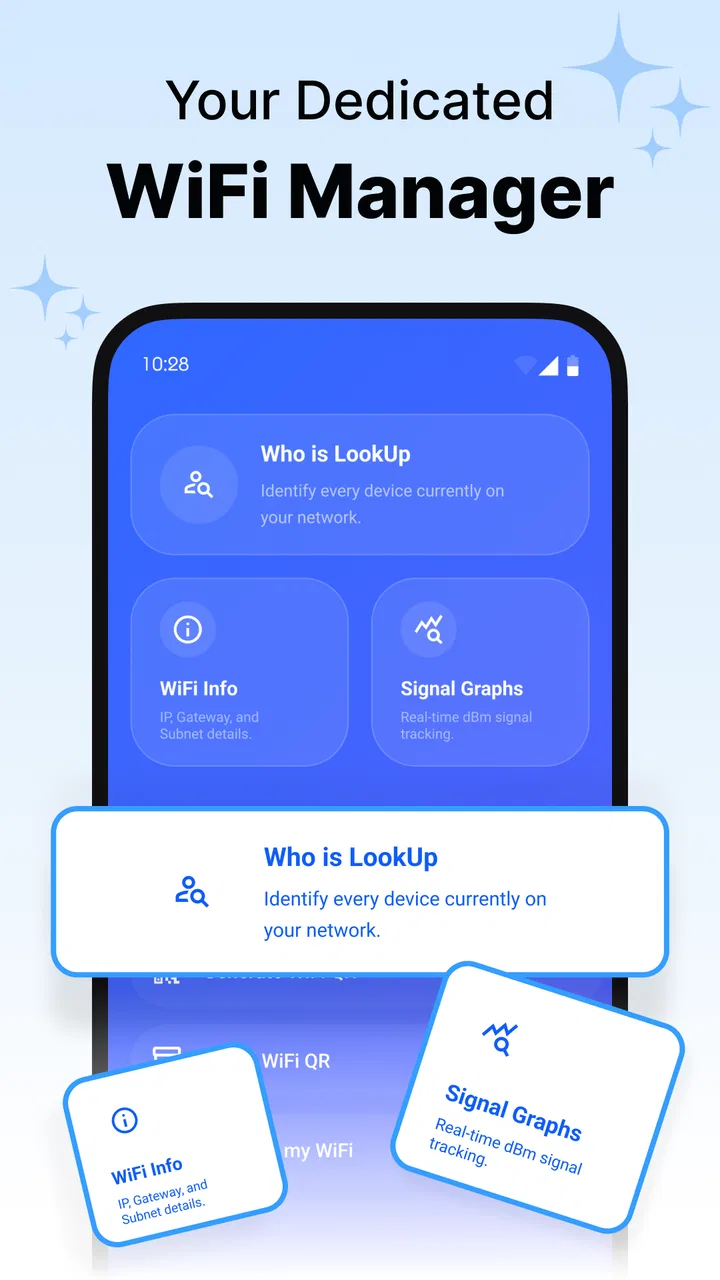
WiFi Assistant – Home Screen
- 4.3
- Rating
- 50.00K
- Installs
- Free
- Price

 Analysis by App-foxy
When I try a personalization app, I want it to earn a place on my home screen rather than simply add another icon. WiFi Assistant – Home Screen takes a focused approach: it is designed as a convenient home screen assistant with WiFi features. That makes the decision fairly simple for some people and less obvious for others. If you regularly adjust your connection or want quick access to WiFi-related actions from the first screen you see, its narrow purpose may be useful. If you are looking for a complete launcher, a deep wallpaper engine, or a broad device-automation suite, you may find its scope too limited.
I reviewed it as a free personalization app from PT. Radjago Aplikasi Indonesia. It is available for everyone, supports Android 8.0 and later, and the current release is version 1.0.1. The app has reached over 50 thousand installs, with a 4.3 average from more than a hundred ratings. Those figures suggest that it has found a real audience, although the smaller review pool means I would still judge it by how well its home-screen idea fits my own routine rather than treating popularity as proof that it suits everyone.
What I would decide before installing it
The first question is not whether WiFi Assistant – Home Screen is attractive. It is whether WiFi access belongs in the part of the phone I use most. I unlock my phone for quick, repetitive tasks: checking a message, opening a map, changing a setting, or confirming that I am on the right connection. An assistant placed around the home screen can make sense when those small actions happen often enough to justify a dedicated space.
You May Also Like

 Blood Strike: 2.5 Anniversary
Blood Strike’s Loadouts Turn Every Drop Into a Tactical Gamble
A close look at Blood Strike’s custom loadouts: how fast access to signature weapons reshapes its battle royale rhythm, rewards preparation, and narrows the gap between fights.

 Pandora - Music & Podcasts
Pandora’s Music Is Easy to Start, but Harder to Recover
Pandora’s strength is its low-effort path from a seed to a station. Its weak spot is how much confidence it asks you to place in connection, setup, and quiet recovery.

 8 Ball Pool
 Is Built on Rivalries, Rematches, and Routine
A close look at the rivalries, rematches, shared routines, and unanswered safety questions that turn a quick pool match into a persistent mobile community.

 Samsung Music
’s Quiet Strength Is Playing What You Already Own
Its reach comes less from spectacle than from dependable access to a personal library. That simplicity is both the app’s strongest retention engine and its ceiling.

 AccuWeather: Weather Radar
AccuWeather Review: A Quick, Clear Forecast for Everyday Decisions
For everyday plans, the best forecast is the one you can understand quickly. AccuWeather makes rain timing, radar, and local conditions easy to act on, with a few trade-offs.

 Hill Climb Racing
Why Hill Climb Racing Still Turns Crashes Into One More Run
A tiny car, a bumpy hill and one more upgrade: Hill Climb Racing keeps resurfacing because its simple chaos makes every near-miss feel personal.
More From Our News Desk



The second question is how much control I want over the rest of my phone. A traditional launcher changes the whole home-screen experience, including icons, folders, gestures, and visual layout. A WiFi-centered assistant has a different job. It should be judged on convenience and visibility, not on whether it can replace every part of a launcher. That distinction matters because many disappointing app choices begin with expecting a focused utility to behave like a complete customization platform.
I would also consider my Android version before spending time setting it up. The minimum requirement is Android 8.0, so older devices are outside its supported range. On a compatible phone, the sensible test is practical: install it, place it where the WiFi controls are easy to reach, and see whether I use those controls naturally during a normal day. If the assistant becomes something I ignore after the first setup, the extra home-screen space is not worthwhile.
Another useful decision criterion is tolerance for a focused interface. Some users enjoy a clean screen with one purpose clearly visible. Others prefer a single control center that gathers mobile data, Bluetooth, brightness, sound, battery tools, and automation together. This app appeals more to the first group. Its value comes from reducing the distance between the home screen and WiFi-related actions, not from promising to manage every setting on the phone.
The home screen is the real product
The most important way to assess this app is to watch what happens during an ordinary transition. Imagine leaving home, arriving at work, or sitting in a café. I may want to check which connection my phone is using before starting a video call or downloading a large file. A home-screen assistant can be helpful in that moment because it puts the relevant task in the same visual area as my other daily shortcuts.
That convenience is different from opening the full Android Settings app. Settings is powerful, but it often requires moving through menus and scanning a longer list. The assistant’s appeal is the shorter path. I do not install it because WiFi management is impossible without it; I install it because repeated small delays can become irritating when I deal with them several times a day.
There is also a useful habit-building angle. I can place the assistant near the apps I use when changing locations, such as maps, transit tools, or messaging. That creates a simple workflow: check the connection, open the relevant app, and continue. This is a more practical use than treating the assistant as decoration. It turns the home screen into a small launch point for a specific routine.
The strongest reason to keep it is reduced friction, not visual novelty. That is the standard I would use after the first few days. If I can reach WiFi-related actions more directly and stop thinking about where the setting lives, the app is doing its job. If I only admire the placement once and then return to the notification shade or Settings, it has not earned permanent space.
Where the focused design works well
For someone who moves between familiar networks, the app’s concept is easy to understand. A student moving between home, campus, and a library may want a visible connection shortcut. Someone who works partly from cafés may want to verify the network before handling a sensitive task. A family member who finds Android’s settings menus confusing may also appreciate a more direct home-screen entry point.
I especially like the idea for phones shared with less technical users, although I would still show them the normal Android controls as a backup. A clearly placed WiFi assistant can make a common action less intimidating. The benefit is not that it teaches networking; it simply makes the relevant starting point easier to find.
Another non-obvious advantage is that it can support a deliberate “connection check” before bandwidth-heavy activity. I might confirm the current WiFi state before backing up photos, joining a long video meeting, or updating several apps. That small pause can prevent the kind of mistake where I assume I am on WiFi when I am actually relying on mobile data. The app does not need to be a full network analyzer to be useful in this workflow.
It can also help when troubleshooting begins with a basic question: is the phone connected as expected? Instead of jumping immediately into advanced diagnostics, I can use the home-screen assistant as the first checkpoint. If the problem is only that I am on the wrong network or need to revisit a connection control, the shorter route is convenient. If the problem requires router inspection or detailed signal analysis, I would move on to tools designed for that job.
Practical routines that make it worth keeping
My preferred setup would be deliberately boring. I would put the assistant in a consistent location rather than moving it around with every home-screen redesign. The point is muscle memory. After a few days, I should know where to tap without searching. This is more valuable than placing it in a visually prominent position and then forgetting its location when the layout changes.
I would also pair it with a simple privacy habit: before using an unfamiliar public network, I would check the connection and avoid assuming that WiFi automatically means safe browsing. The assistant can make the connection easier to reach, but it cannot turn an untrusted network into a trusted one. That distinction is important, especially for people who interpret a convenient WiFi control as a complete security feature.
A second useful workflow is travel preparation. Before leaving a hotel or rental apartment, I could use the home-screen shortcut to check the connection state, then disable or change what I need before heading outside. The value here is consistency. Rather than remembering which settings page contains the relevant control on every phone, I have one familiar starting point on the device I am carrying.
I would not expect the app to replace Android’s notification shade. The shade remains the natural place for quick system controls, and many users will reach it faster because it is available from almost anywhere. The assistant has a different advantage: it is visible as part of the home-screen layout and can sit beside the apps associated with my connection routine. Whether that is better depends on where my hand naturally goes first.
Where another category may fit better
A full launcher is the better choice for someone whose main goal is broad personalization. If I want custom icon packs, extensive gesture behavior, elaborate folder systems, or a completely different home-screen structure, I would start with a launcher rather than a WiFi-focused assistant. The two categories can overlap in daily use, but they solve different problems.
Android’s built-in settings and notification controls may be enough for users who change WiFi only occasionally. There is no reason to add a dedicated home-screen element for a task I perform once every few weeks. In that situation, the default tools are likely simpler because they require no additional layout decision and already belong to the operating system.
Network-analysis apps are also a better fit for a different kind of user. If I need channel information, signal comparisons, troubleshooting details, or a deeper look at network behavior, a basic home-screen assistant is not the category I would choose. I would look for a specialist tool and accept a more technical interface in exchange for more diagnostic depth.
Automation apps may be preferable when the real goal is to make connection behavior happen automatically. For example, a user might want actions tied to location, time, or a particular routine. A shortcut-oriented assistant can make a manual action easier, but it is not the same as a rule-based automation system. I would not install this app expecting it to remove every manual step from my networking habits.
There is a trade-off with visual simplicity, too. A person who maintains a very minimal home screen may see any additional assistant as clutter. Even a useful widget or shortcut competes with space for communication, work, and personal apps. In that case, the right alternative may be no extra personalization app at all. The default Android layout can be the cleaner solution.
What the switching cost feels like
Because this is a free app, the financial barrier is low. The more important cost is attention. I need to decide where it belongs, learn its placement, and give it enough time to become part of my routine. If I already use the notification shade without thinking, switching may not save me anything. The app has to be faster or more comfortable in my specific pattern of use.
There is also a layout cost. Moving an existing icon or assistant into a prime home-screen position can disturb a setup that already works. I would avoid rebuilding the entire screen around it at once. A better approach is to test it in a secondary position first, then promote it only if I reach for it repeatedly. This makes the trial reversible and prevents a small utility from creating unnecessary home-screen disruption.
For people who use another launcher, compatibility with their personal layout becomes part of the decision. I would treat the assistant as something to fit into that arrangement, not as a reason to abandon a launcher I already enjoy. If the two approaches compete for the same space or make the screen feel crowded, I would keep the tool that supports more of my daily actions.
Switching back should be straightforward from a decision-making perspective: if I stop using the assistant, I can return to the system’s normal WiFi controls and reclaim the home-screen space. That makes experimentation reasonable. Still, I would not confuse easy removal with guaranteed usefulness. A low-cost trial is worthwhile only if I evaluate it against real habits rather than keeping it installed out of curiosity.
Who should use it, and who should skip it
I would recommend trying it to people who frequently move between WiFi environments and want a visible, home-screen-based way to reach connection features. It also makes sense for users who find the Android Settings path too buried or who want a dedicated starting point before joining a call, checking a download, or troubleshooting a connection.
I would be more cautious for users who rarely touch WiFi settings, prefer an uncluttered home screen, or already have a launcher arrangement that gives them equally quick access. They may install it, discover that the notification shade is still faster, and end up with one more element to maintain. The app is not a universal upgrade; its usefulness depends heavily on repetition.
I would also skip it if my primary need is network security, detailed diagnostics, or automated device behavior. Those needs belong to other categories. A focused assistant should not be criticized for failing to become a complete networking laboratory, but it should be chosen honestly for the convenience it actually targets.
My recommendation after weighing the trade-offs
WiFi Assistant – Home Screen is a sensible experiment for Android users who want WiFi access to feel closer to the rest of their daily home-screen actions. Its free price removes the biggest practical objection, and its Everyone content rating makes it approachable for a broad audience. The 4.3 average and growing install base are encouraging signs, while the current version, 1.0.1, still makes me view it as a focused tool that should be judged by routine rather than by a long feature history.
My recommendation is conditional but positive: install it if you can name a recurring WiFi task that currently feels unnecessarily buried. Place it where you naturally look, use it during a real transition such as leaving home or arriving at work, and keep it only if it shortens that routine. That test is more meaningful than simply opening it once and deciding whether the interface looks useful.
For me, the app’s best quality is clarity. It does not need to compete with a full launcher or a specialist network analyzer to have a place on the phone. It only needs to make WiFi-related access more convenient than my current habit. If your priority is a small, practical home-screen shortcut rather than total device customization, this is a reasonable free option to try.
FAQs for WiFi Assistant – Home Screen
01What is WiFi Assistant – Home Screen and how does it work?
WiFi Assistant – Home Screen is an app designed to enhance your home screen by providing quick access to WiFi network settings. It offers seamless connectivity management, allowing users to switch networks, view connection details, and optimize their internet experience directly from the home screen. The app simplifies network management, making it accessible and efficient.
02Is WiFi Assistant – Home Screen safe to use?
Yes, WiFi Assistant – Home Screen prioritizes user security by following strict data protection protocols. The app does not collect personal information without consent and uses encryption to safeguard your connection details. Regular updates ensure the app remains secure and compatible with the latest operating system enhancements, providing peace of mind for users.
03Does WiFi Assistant – Home Screen require a lot of battery power?
WiFi Assistant – Home Screen is designed to be efficient, minimizing battery usage. It runs in the background only when necessary, ensuring that it doesn’t drain your device's battery. The app’s developers have optimized it to use minimal resources, allowing it to function smoothly without affecting your device's overall performance.
04Can I customize the settings in WiFi Assistant – Home Screen?
Absolutely, WiFi Assistant – Home Screen offers various customization options. Users can personalize their home screen widget, choose which network details to display, and set preferences for automatic network switching. The app’s intuitive interface makes it easy to adjust settings to fit individual needs, enhancing user experience and connectivity management.
05Is WiFi Assistant – Home Screen compatible with all devices?
WiFi Assistant – Home Screen is compatible with most Android and iOS devices. However, it’s important to ensure your device meets the minimum operating system requirements specified in the app store. Regular updates are released to maintain compatibility with new devices and OS versions, ensuring a broad range of support for users.
Pros
- User-friendly interface for easy navigation.
- Quick connection to nearby Wi-Fi networks.
- Saves mobile data by auto-connecting to Wi-Fi.
- Provides secure connections with encryption.
- Lightweight app that doesn't slow down device.
Cons
- Limited to certain regions for optimal use.
- Ads can be intrusive during use.
- Requires location access for functionality.
- May disconnect if signal is weak.
- Some features require in-app purchases.

WiFi Assistant – Home Screen
Gallery